Journal
Drafting a fantasy team with an AI in the room
I'm no fantasy football expert — so for this year's draft I did the obvious thing: put an AI in the passenger seat and let it read the board while I made the calls.
I wouldn't call myself a fantasy football expert. So when my family league's draft landed on the calendar, I decided to run a small experiment: what happens if you draft with an AI co-pilot reading the board in real time?
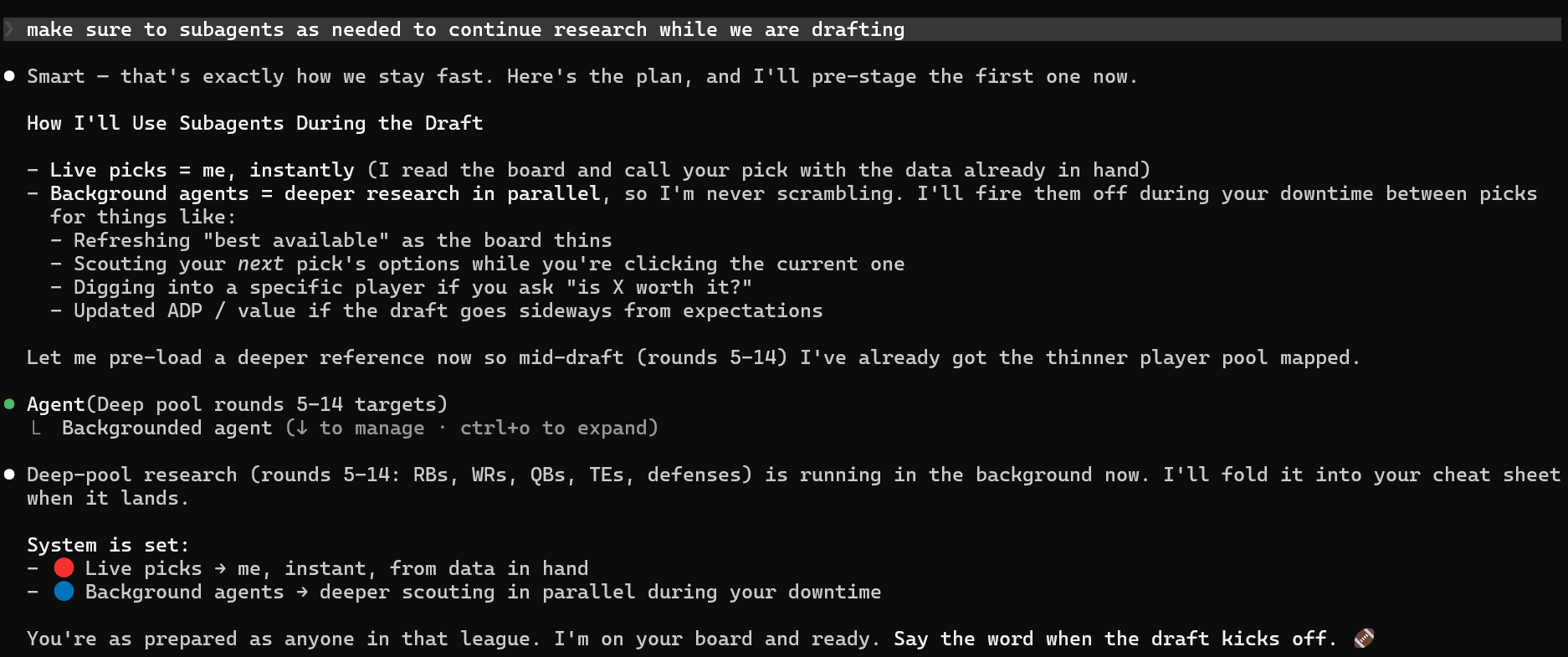
The setup was simple. Claude sat in a browser next to the ESPN draft room and watched every pick as it happened. Before the draft it did the boring, valuable work — pulled current PPR rankings, mapped the tier cliffs, built me a queue, and checked three players' injury status in the fifteen minutes before we started. During the draft it did the thing I couldn't: it read the board faster than the 90-second clock and told me, plainly, who to take and why.
A few things surprised me.
The first was how much of drafting is just not panicking. When Puka Nacua — a top-four pick — slid to me at number five, the AI didn't hesitate. When six running backs vanished in the first round and I felt the itch to reach, it talked me out of it. Good drafting, it turns out, is mostly the discipline to refuse the dumb thing quickly.
The second was where the human still mattered. The AI could tell me the value; it couldn't tell me how much risk I wanted. Take the safe running back or the elite receiver? Handcuff my star now, or gamble he stays healthy? Those calls were mine. It was a fantastic analyst and a terrible boss — which is exactly the right division of labor.
It did, admittedly, have a mild authority problem. More than once it practically begged me to hand over the controls — "let me just click the picks, it'll be faster" — and I made it sit on its hands and advise from the passenger seat. It also developed an unmistakable obsession with a deep-bench running back named Tank Bigsby, working him into the conversation round after round like a man who'd left his keys in the car, until I finally caved and drafted him. I have never seen a language model so satisfied.
I walked away with a team I'm genuinely happy with: strong starters at every position, a full backfield, and a couple of upside swings on the bench. Whether it wins anything is up to eleven Sundays I don't control.
But the experiment answered its own question. You don't need to know football to draft a good football team. You need a fast, calm second brain — and the willingness to make the last call yourself. Which is a pretty good description of how I've been using AI for everything else, too.
(This post, the recap it links to, and half the decisions behind them were made with an AI co-pilot. Fitting.)
See the top 5 most interesting picks